Monday, November 7, 2011

Why Mad?


My fascination of the word "mad" sprouts from its many connotations in modern language usage, both common and uncommon. The most abundant usages of the word are as an adjective to describe an emotion, or as an adjective to add to the meaning of another adjective. Before I discovered the slang version of the word while visiting my family in New York, I thought that the only usage of the word mad was when referring to an angry feeling someone may feel. My Northeastern cousins, however, would use the word mad to add to a description of something. For example, they would say, "That movie was mad cool," meaning that it was really cool. Since my apprehension of this usage, I too have used it in my daily vocabulary.
 My historical knowledge of the word mad is limited. Because of this, I am interested in looking deeper into the origin of the word and how its multiple meanings came to be. Whether its slang or its intended meaning, the usages of the word "mad" are extremely different, and sometimes opposite of each other. This is somewhat confusing, but very interesting as I begin my research on this single word. I am nervous that I will not be able to find the origins of some of the meanings; however, I think that many of them have existed for a long time. I am looking forward to focusing on the original meaning of the word, and how it has progressed to its most common usages.

Sunday, October 30, 2011

"Frankenstein and Radical Science" by Marilyn Butler

- Butler's main focus is on the differences between the revisions Shelley made on her novel Frankenstein. Her first main argument is that the revised version published in 1831 focuses more on the religious aspects of creation and Frankenstein's remorse for his actions rather than the original theme of mechanic vs. vitality.
- She gives evidence to the divided opinions around the concept of creation and if it was merely scientific or if there was some entity responsible. The article discusses the major debates in 1814-19 between Lawrence and Abernethy, two Professors at London's Royal College of Surgeons, on the origins of life and nature.
- Butler demonstrates how the friendship between Shelley and Lawrence, the Professor who defended the position of the materialist, is a possible reason for the novel's original focus on this point.
- The next main discussion that Butler focuses on is concerning the species of the creature and if it should be deemed something sub-human. Butler makes note that never in the text is the creature called a different species. She also makes it clear that the creature is, more or less, a type of survival story, similar to that of Robinson Crusoe.
- The last main point made throughout the article is the focus on the parent-child relationship and how that plays a major role in the overall significance of the novel. Butler argues that Shelley includes Lawrence's views on the importance of the parent-child relationship in really creating a true "human experience." This can be seen when follow the story of the creature and how he does not have a parent, thus making him into the daemon he is called. However, this can be argued in that the daemon is very human in that he is able to make a life for himself and survive without the assistance of a human parent.

Sunday, October 2, 2011

Beowulf and The Bourne Trilogy: Two Works with a Similar Theme Concerning Heroism

As expressed in both the epic poem Beowulf and The Bourne Trilogy movie series, Heroism is a quality that must be earned by completing a certain level of task that society deems honorable. Although it may seem obvious that an early Anglo-Saxon story and a twenty-first century movie sensation describe completely different societal expectations for earning honor, the concept is the same in that both must accomplish a certain task that proves competency.  However, the reasons behind both of these characters’ want to affirm themselves as heroes are unique to each protagonist.  Beowulf wishes to defeat Grendel, Grendel’s mother, and a dragon in order to save the mead hall of his king, Hrothgar, and become the honorable warrior that his society will praise. Jason Bourne’s mission is to uncover the secrets of his false identity created by the CIA so that he can prove to his associates, and himself, that he is not the killer that the government created him to be. Overall, both Beowulf and The Bourne Trilogy use a similar theme concerning honor in order to develop a thick plot with a fascinating character struggling with an individual problem.
            Beowulf is a dedicated warrior wanting to further show his talents to the king of Danes by defeating the infamous supernatural beings that are causing havoc on the community. It is made clear throughout the epic poem that honor, strength, and loyalty in a warrior are determining factors of a successful male individual. Even at the beginning of the poem, the author gives a clear description of what a true, respectable prince/warrior must do by saying, “And a young prince must be prudent like that,/ giving freely while his father lives/
so that afterwards in age when fighting starts/
steadfast companions will stand by him/
and hold the line. Behaviour that’s admired is the path to power among people everywhere” (Norton, 31).  Beowulf sets out to follow these simple instructions by first tackling the first obstacle of Grendel, which he is able to successfully accomplish through an impressive battle. However, when Grendel’s enraged mother attacked to avenge the death of her son, the battle was not an easy one, and it was not until the last parts of the fighting that Beowulf was able to kill her. During this battle he had courage, strength, and strategy: all respected characteristics of a good warrior in Beowulf’s society. And with the final battle with the dragon, Beowulf and his trusted companion Wiglaf fight even after most of their followers abandoned them as the result of fear for the beast. During this battle, Beowulf fights until he is terribly injured, and dies soon after. Thus, Beowulf participates in dangerous attacks in order to prove his abilities as a fighter and as a leader. The background information given about societal norms is important in order for the text to not only be a descriptive story, but a significant piece of history- telling literature.
            Jason Bourne, on the other hand, is a different type of warrior who is dedicated to proving to his close associates, and himself, that he is not who the government says he may be by traveling great lengths and getting into very dangerous situations. Bourne, as explained in the first movie The Bourne Identity is a special asset of the CIA whose occupation is to assassinate certain individuals that the government feels obligated to eliminate. However, on one mission when his task is to terminate the life of an exiled African leader named Nykwana Wombosi, Bourne is unable to complete the task because the man’s children are present in the room, so he is consequently shot by a bodyguard and left in the Mediterranean Sea. When he awakes on an Italian fishing boat that rescued him from the sea, Bourne realizes that he has no memory of his own personal life, meaning he has no idea of anything about his life, except for what his flashbacks tell him. Throughout the series in the next movies The Bourne Supremecey and The Bourne Ultimatum, Bourne travels from Berlin to Moscow and encounters many difficult fights and attacks in the search for clues that will lead him to finding out the truth about his existence. Although the CIA is working against him in order for him to not get the information he desires, Bourne is eventually able to complete his task and prove that he is indeed a man named David Webb who was placed in the CIA’s top-secret program to train heartless killers. Thus, Bourne is able to use his skills as an independent problem solver to find out the details about his identity and his past. His task is indeed a mission of acquiring honor and respect because he no longer wants to be a assassin, and he is out to prove that he is more than what the government has created him into. Jason Bourne, like Beowulf, is fighting for respect and dignity by uncovering the cobwebs of conspiracy that were created to establish him as an asset.
            Although their differing time periods establish a clear distinction between Beowulf and The Bourne Trilogy, both deal with how a main protagonist reacts to becoming what their society deems heroic. Beowulf and Jason Bourne deal with extremely different circumstances and battles, but both are successful in proving themselves as successful warriors. Beowulf defied all odds and was able to defeat all 3 of the beasts and bring his community back to safety, while also being named king. Jason Bourne was able to uncover the secrets behind his past without having any memory, and while also being followed by the CIA, a powerful organization wanting to defend the conspiracy at any cost. In conclusion, regardless of the differences in time and plot, Beowulf and The Bourne Trilogy are very similar pieces of story-telling that explain the struggles and final successes of two individuals on a mission to prove to their community that they are all the qualities needed to be respectable. 

Wednesday, September 21, 2011

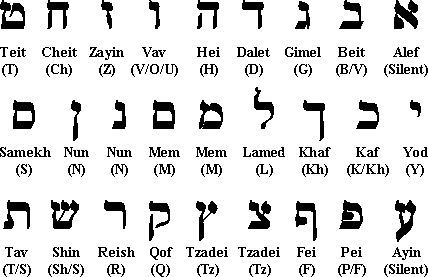
The History of Hebrew Influencing the English Language

- Hebraism is a term  used to describe manners, customs, spirit or character of the Jewish people. However, it is also used to describe a linguistic feature of the Hebrew language that is found in particular language. 


- For example, words such as Alphabet, Bath, Camel, and Cider, all originate from the Hebrew Language. 


- According to Hebrew language scholar Dr. Isaac Elchanan Mozeson's conclusions, "... English and Hebrew are profoundly connected. " Mozeson also states that many other words in the English language should be deemed Hebrew by origin. (http://ensignmessage.com/archives/hebrew1.html)


But when did Hebrew begin to matriculate into the Old English Language? 


During the age of the Renaissance in the 17th Century, Religious scholars took deep interest in the Old Testament, written in Sematic characters. Along with this popular interest, People in England, especially those involved in the Puritan movement under Oliver Cromwell, believed Hebrew to be "The Mother of Languages." Thus, Hebrew was set at a different level. Cromwell even gave the position of Secretary of Foreign Language to the poet and dedicated Hebraist John Milton. 


Below is a direct quote  from the article "The Mother of Languages" by Norman Berdichevsky. 


The contribution of Hebrew is less obvious but often overlooked precisely because it has become so familiar in its anglicized forms. The foremost Jewish historian of our time, Cecil Roth, had this to say:


"Generation after generation of Englishmen heard the Bible read in church and studied it at home. In many cases, it was the only book; in all, the principal book. At last its cadences, its music, its phraseology, sank into his mind and became part of his being... Hence by slow degrees his daily speech was not merely enriched, but to some extent moulded by its influence."


Thursday, August 25, 2011

Literature That I Would Read Again, and Again

1. A Tree Grows in Brooklyn, Betty Smith. I read this book in the 8th grade, and I have read it 3 additional times. I love the story line and how the description of Williamsburg really does mirror my own recollection of it. The main character's perception of her surroundings made a large impact in how I observe the natural and unnatural world around me.

2. The Outsiders, S.E. Hinton. This is one of my favorite books of all time for many reasons. Firstly, the characters, their names, and their overall meaning to the book is really unique in that they all correlate to create a very emotional story. The references to teen alcoholism and drug use contribute to the emotion behind the story itself, which is to almost teach the reader how gang violence, abusive homes, and close knit friendships may affect a teenager.

3. And Then There Were None, Agatha Christie. This is one of my all-time favorite mysteries because of the suspense that the story creates. The reader never really knows when or where a person may die next. Also, the culprit of the crime never seems obvious.

4. Metropolis, Elizabeth Gaffney. Anyone could ask me any question about this book and I would be able to answer it right away because it was my ID book for Mr. Martin's class. Also, it was a book that I really enjoyed reading because if its exciting features. The book follows a almost mystery man who recently immigrated to New York City from Ireland in the hopes of creating a new life for himself. However, he is shocked to find that the streets of NYC are not paved with gold, but rather dirty and full of crime. The ups and downs of this book really craft it into an excellent novel that I am truly happy I wrote an almost 30 page paper on.

5. Any Harry Potter books, by J.K. Rowling. The concept of Harry Potter is something that I have loved ever since my mother allowed me to read the first book. The description and creativity of the novels is absolutely brilliant. And it is quite remarkable to think that Rowling first began writing on napkins in local cafes in London.

6. The Series of Unfortunate Events, by Lemony Snicket. Yes, there books are quite childish and at some times depressing, but it was the first book, that I remember, that I could not put down. I read these books so fast that I was at Barnes and Noble buying the next book every couple days.

7. The Great Gatsby, by F. Scott Fitzgerald. This book I have read twice, once in the 8th grade and once last year. I loved it even more after reading it the second time because I was able to look at the text with a wiser perspective. Gatsby is an incredible character whom I think really does make the story. I love the description that goes into the book. And since I have been to Long Island many times, I am able to picture where exactly the book takes place.

8. The Doorbell Rang, Rex Stout. This is one of the most interesting books I have ever read because it was a mystery, yet it was designed very differently than the average mystery book. This detective novel had interesting characters, interesting relationship, yet very convincing evidence. I really enjoyed this book and was able to do a very good project on it which went deeper into the connection's the book gave concerning the FBI.

Tuesday, August 23, 2011

My Opinion On The Book The Picture of Dorian Gray and its Story Line

I recently finished the book The Picture of Dorian Gray, which at parts had excellent story telling. The storyline of the book is a very complex subject that deals with the dilemma of growing old, and I believe that Oscar Wilde, its author, does indeed use great storytelling techniques to help make the complex topic more understandable. For example, when Basil finishes the portrait of Gray and then shows him, Dorian speaks about his sadness concerning growing old. The passage, “How sad it is! I shall grow old, and horrible, and dreadful. But this picture will remain always young. It will never be older than this particular day of June... If it were only the other way! If it were I who was to be always young, and the picture that was to grow old! For that-for that-I would give everything! Yes, there is nothing in the whole world I would not give! I would give my soul for that,” contributes a lot of emotion to the story, thus making it easy for the reader to see that Dorian does indeed wish to trade his soul for eternal youth. Although the book was written in the in the late 19th century, Wilde does a grand job at really explaining how indeed Gray does become young forever, and emphasizes how by including this commentary. Something that I personally believe separates the good books from the bad ones is the authors’ ability to convey complex ideas using simple and understandable language. Wilde does not do this often in his text as many of his chapters, especially one in particular are quite confusing; however, in this particular passage, Gray’s wishes are expressed quite simply, which helps the reader follow the storyline. At the beginning of the book, I regretted choosing the text because I thought it would be a very dry read, but by the time I finished, I really did enjoy the story and how it ended.